
The Product Catalog is one of the most important building blocks of Revenue Cloud / Agentforce Revenue Management. Getting this foundation right is essential for everything that follows.
The Product Catalog model can look complicated at first, but the core concepts are actually quite straightforward once you understand how they fit together.
Here is the simplified version with the key objects and their relationships in an easy-to-understand way. The aim is not to cover every object in the model, but to focus on the core structure you should understand first before diving deeper into Revenue Cloud.
Let's start with the simplified ERD and walk through it step by step.
Revenue Cloud - Simplified Product Catalog Data Model
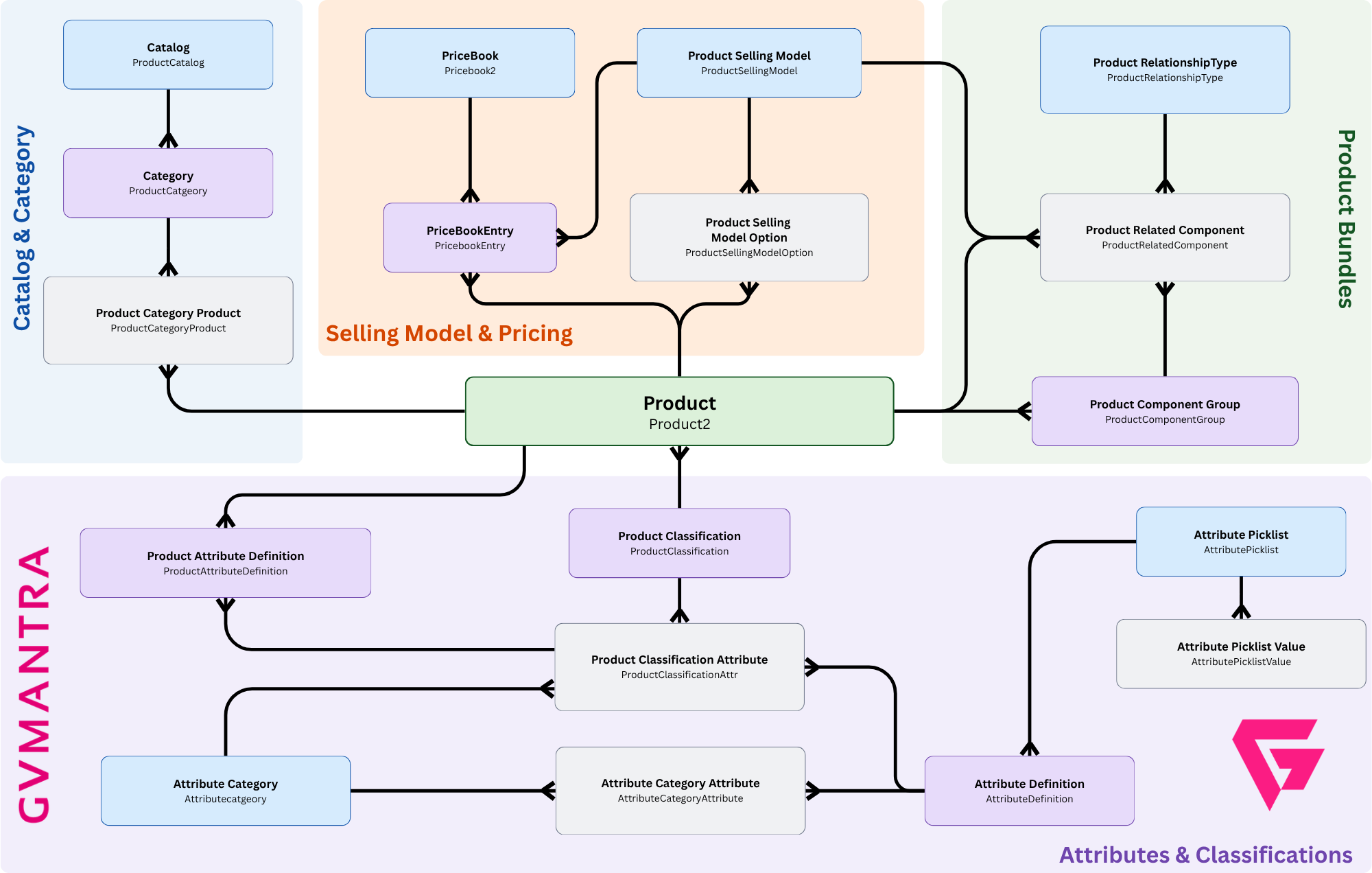
The following sections give a short and simple description of each core object, with some examples.
Product & Catalog
| Object | Purpose / Use |
|---|---|
| Catalog | Represents a catalog used to organize products and product categories. Example: a company can maintain a catalog containing the products it offers. |
| Category | Groups products into logical categories within a catalog. Categories can also be organized hierarchically using ParentCategoryId. Example: Electronics → Laptops → Business Laptops. |
| Product Category Product | Junction object that associates Product2 records with ProductCategory records. Example: a Laptop product can be associated with the Laptops category. |
| Product | Represents the product or service that the business sells. It can also represent a product used as part of a bundle. Example: Laptop, Support Service, or Internet Plan. |
Product Bundles & Relationships
| Object | Purpose / Use |
|---|---|
| Product Component Group | Groups components that belong to a bundled product. Example: a Laptop Bundle can have component groups such as Hardware and Accessories. |
| Product Related Component | Defines a relationship between a parent product and a related/child product component in the product structure. Example: Laptop Bundle → Mouse and Laptop Bag. |
| Product Relationship Type | Defines the type of relationship between products. It provides the relationship classification used by product relationships. |
Product Classification & Attributes
| Object | Purpose / Use Case |
|---|---|
| Product Classification | Provides a reusable classification/template for products and the attributes associated with that classification. Example: a Laptop classification can contain RAM, Processor, Storage, and Color attributes. |
| Product Classification Attribute | Associates Attribute Definition records with a Product Classification. Example: Laptop Classification → RAM, Storage, Processor. |
| Attribute Definition | Defines a product attribute, including its label/name and data type. If the data type is Picklist, the attribute is associated with an Attribute Picklist. |
| Attribute Picklist | Defines a reusable set of possible values for picklist-type attributes. Example: a Color picklist can contain Black, Blue, Silver, and White. The same picklist can be reused by multiple attributes. |
| Attribute Picklist Value | Stores an individual value belonging to an Attribute Picklist. Example: for the Color picklist, Black, Blue, Silver, and White are individual Attribute Picklist Value records. The value record can have a name, abbreviation, unique code, status, default flag, display value, actual value, and sequence. |
| Attribute Category | Groups related attributes into a logical category so attributes can be organized for product classification/configuration. Example: Hardware Specifications can contain RAM, Processor, and Storage. |
| Attribute Category Attribute | Junction object that associates Attribute Definitions with Attribute Categories. Example: Hardware Specifications → RAM, Processor, Storage. |
| Product Attribute Definition | Associates an Attribute Definition with a specific product. Products can inherit attributes through their classification and can have product-specific configuration/overrides. |
Product Selling Models
| Object | Purpose / Use Case |
|---|---|
| Product Selling Model | Defines how a product is sold, such as one-time or subscription-oriented selling models. Example: a physical laptop may be sold once, while a service may be sold for a term. |
| Product Selling Model Option | Associates a Product2 with a ProductSellingModel so the product can be sold using that selling model. Example: Internet Plan → Evergreen selling model. |
Price Book & Pricing
| Object | Purpose / Use Case |
|---|---|
| Price Book | Represents a price book used to organize product pricing. Example: Standard Price Book or a specific regional/customer price book. |
| Price Book Entry | Associates a product with a price book and stores the product's price-related entry for that price book. The diagram also shows the relationship to Product Selling Model. |